

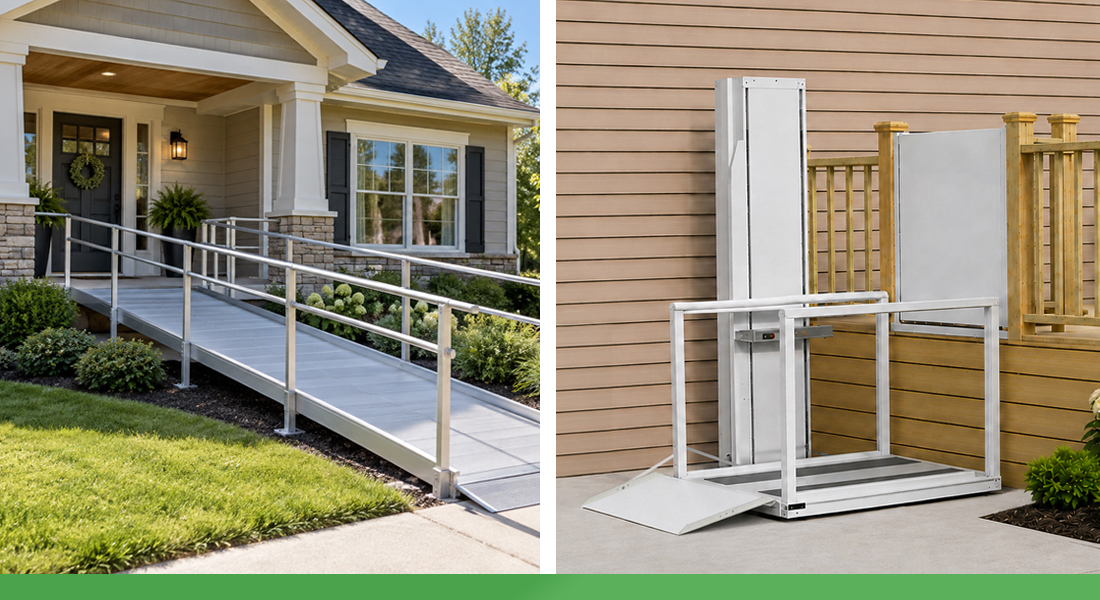
When an entrance to a home has steps, two commonly considered accessibility solutions are: a wheelchair ramp and a vertical platform lift. Both can create a more accessible route, but they use space very differently and may suit different homes, elevations, users, and long-term plans.
The right solution is about more than easy installation. It’s about finding what fits your staircase, meets your mobility needs and provides a safe, comfortable way to move throughout your home.
How the two solutions work
A wheelchair ramp provides a smooth, gradual path between different levels, making it easier to navigate entrances and steps with a wheelchair, scooter, walker or other mobility aid. Ramps are available in a variety of styles and configurations to accommodate different homes and accessibility needs.
A vertical platform lift (VPL), sometimes called a wheelchair lift, provides another another convenient way to overcome steps and changes in elevation. Rather than extending outward like a ramp, a VPL travels straight up and down like an elevator, carrying you and your mobility device between levels while taking up less space.
Space is often the deciding factor
Space is often the deciding factor
A ramp needs enough length to create an appropriate slope, along with landings and turning space where required.
A VPL may still require a suitable installation area and safe access at both landings, but it does not need to travel the same horizontal distance as a ramp.
Compare the complete daily experience
- Route: Is the ramp path direct up and down, or would the user travel through multiple turns and landings?
- Effort: Can the person comfortably use a wheelchair along the proposed ramp, or will assistance be available?
- Mobility device: Confirm that the route or lift can accommodate the user and the device they use.
- Weather: Rain, snow, ice, drainage, and sun exposure can affect outdoor access and maintenance.
- Other users: Consider caregivers, deliveries, visitors, and emergency access—not only the primary user.
When a ramp may be the better fit
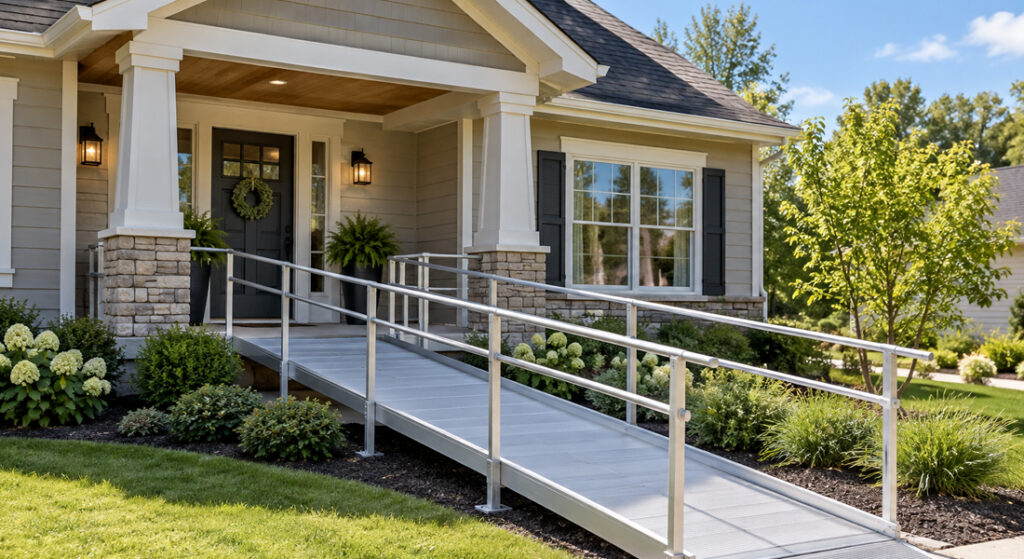
A ramp can be a straightforward, non-powered route when there is adequate room. It may also serve a broad range of users without requiring them to operate equipment.
For a relatively small elevation change and a property with sufficient space, a ramp may integrate naturally into the entrance. The design should still be evaluated for the user’s strength, mobility device, weather exposure, and local requirements.
When a VPL may be the better fit
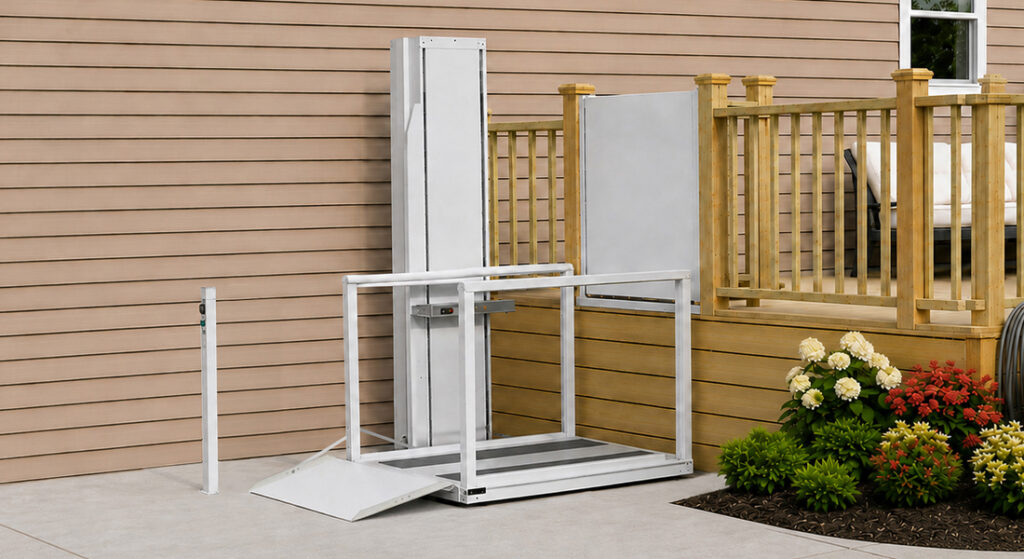
A VPL may be preferable when the entrance is too high for a practical ramp layout, space is limited, or the user would find a long incline difficult. A VPL can also provide a direct route between levels while preserving more of the surrounding property. The installation must be planned carefully. Platform size, travel height, gates, landings, electrical needs, drainage, environmental exposure, and local requirements can all affect the final solution.
Questions to ask before choosing
- What is the exact vertical rise?
- How much clear space is available?
- Will the solution be indoors, or outdoors?
- What mobility device and combined load must it accommodate?
- Can the user operate the equipment independently?
- What site preparation, permits, inspections, or local code requirements may apply?
Choose for the home you have and the access you need
A ramp and a vertical platform lift can both improve accessibility, but they solve the elevation challenge in different ways. A ramp trades horizontal space for a gradual path. A VPL uses powered vertical travel to reduce the length of the route. Evaluating the user, the entrance, the available space, and the long-term plan together leads to a more useful decision.
Explore our vertical platform lifts or contact one of Mobility Specialist to discuss the entrance and accessibility goals for your home.